Questions and Answers Hub
How do you maintain a rope bridge?
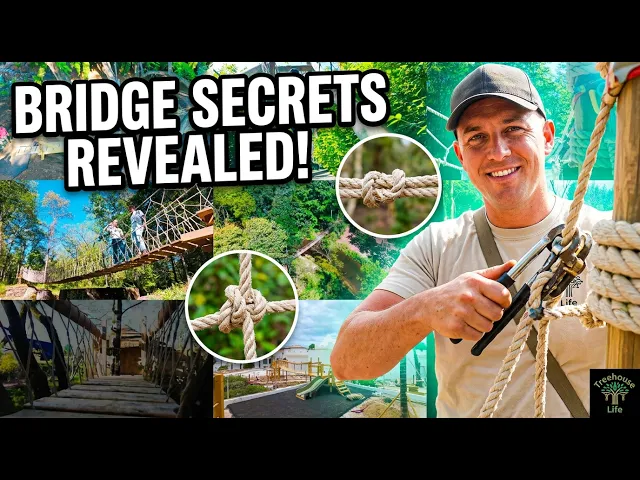
A rope bridge requires a three-tier inspection programme: daily visual checks before each opening, operational inspections every one to three months and a comprehensive annual review by a qualified independent inspector. Treehouse Life International provides detailed maintenance manuals, component checklists and hands-on training for every level - so your team keeps each crossing safe and full of adventure.
FAQ Type:
Problems Concerns and Solutions
Seeking:
Considering
Product Category:
Rope Bridges


Maintenance thinking goes into every bridge we design before a single component is specified. Not as a checklist added at the end - as a structural consideration that shapes material choices, fitting selection and the details that determine how easy or difficult a bridge will be to inspect and care for over its working life.
Every bridge we complete leaves with its own bespoke maintenance and safety manual. Not a generic document with the project name added to the cover - a manual specific to that bridge, that site, every component and every inspection point relevant to how and where it will be used.
The inspection programme runs in three tiers, and we build it to be manageable for operators of every scale. A private estate with a single crossing. An adventure park running dozens of aerial elements across a season. The commitment required is different in each case, but the principle is the same: a bridge checked well and checked consistently will repay that attention with years of safe use. Wear caught early is wear addressed cheaply. Wear missed is something else entirely.
Training covers more than the technical inspection process. We equip your whole team — not just a designated inspector - with the knowledge to read a bridge in daily use: to recognise early signs of wear on webbing slings or rigging screws, to understand what needs attention now and what can wait for the next scheduled check, to guide visitors through the experience with the kind of quiet confidence that comes from actually understanding what is beneath their feet.
For the annual periodic inspection, we recommend independent specialists - companies such as Capstone Inspections, who hold the Type A classification defined by EN ISO/IEC 17020. Impartial, qualified, with no stake in the outcome beyond accuracy. That combination of daily care from your own team and independent annual scrutiny from a qualified third party is, in our experience, the most valuable investment you can make in the long life of a rope bridge.
Not the materials. Not the span. The care.
Off-the-shelf rope bridge kits, prefabricated crossing systems, catalogue products with assembly instructions - that is not what we manufacture. If that is what your project calls for, specialist playground equipment suppliers or modular adventure course companies will serve you better and more directly than we can.
If you already have a rope bridge built by another company and need a third-party maintenance contractor or independent inspector, we are also probably not the right fit. Our inspection and training programmes are built around bridges we designed and installed ourselves — structures where we know every joint, every fixing, every tree the anchor points sit in. Inspecting someone else's work, built to different specifications with different components, is a different discipline and not one we would approach with the same confidence.
For independent inspection on an existing structure, a qualified inspector accredited to EN ISO/IEC 17020 - Capstone Inspections, or a similar specialist - is the appropriate partner. For tree-specific assessments, an independent consulting arboriculturist brings the species and health expertise that sits outside our scope and squarely within theirs.
We are always glad to point you toward the right people if you reach out. Knowing where your project belongs is as useful as knowing where it doesn't.