Being Niche, embracing Scarcity and always World-Class
Why a treehouse grows with your child
Subject:
Childhood
The most common worry about building a treehouse is that a child will outgrow it. The structure that thrills a five-year-old, the thinking goes, will sit abandoned by the time they reach their teens. Yet the families who have lived with one for years tell a different story.
A well-made treehouse does not get left behind; it changes meaning as the child changes, holding a different kind of importance at six, at thirteen, and at twenty. What endures is not the play itself but the emotional space - the private kingdom that remains theirs to return to.
Understanding why that happens reveals what actually makes an outdoor structure worth building, and what to look for if you want one that lasts a childhood rather than a season.
If you are wondering whether a treehouse is worth the investment when children grow so quickly, the honest answer from those who have watched it play out over decades is that the structure rarely becomes obsolete. It becomes something else. The reason is that a treehouse, when designed well, is never really about the house at all. It is about creating a space a child can claim as their own - and ownership of that kind does not expire on a particular birthday.
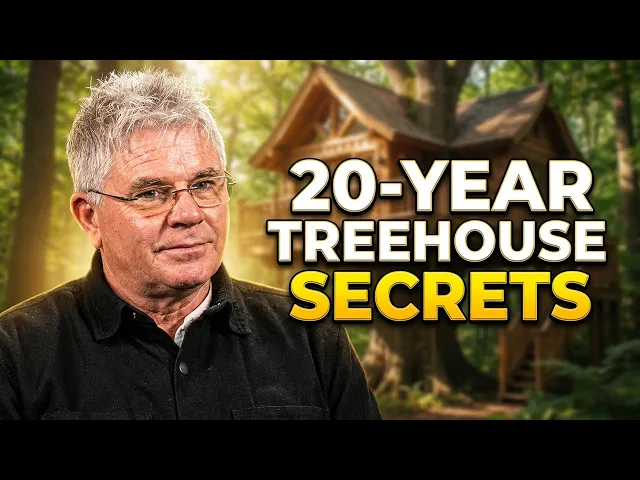
This is the distinction Paul Cameron, founder of the UK's longest-standing treehouse company, has spent twenty-five years refining. He is candid that the word "treehouse" misleads people. For most, it conjures a square house with a door and two windows. There is always a house as part of a project, but he treats it as one small part of something larger. To him the word is really a collective term for childhood itself - for imagination and play, for whatever the structure becomes from one day to the next. It is a café in the morning, a castle by afternoon, a theatre, a school, a ship. The fixed timber holds still while the meaning a child pours into it shifts endlessly.
That openness is precisely what allows a treehouse to grow with a child. A structure designed around a single function dates quickly. A space designed to be filled by imagination never does, because the imagination filling it keeps maturing. Children, Cameron observes, are extraordinary at pretending - superheroes at it - in a way most adults slowly lose. Giving that instinct a dedicated home outdoors, rather than letting it fade indoors, is the real gift. And it is increasingly a rare one: as childhood moves indoors and onto screens, the unstructured outdoor play where imagination develops is quietly disappearing. A treehouse is one of the few things that reliably pulls a child back into nature and into their own inventiveness.
The evidence that it lasts comes from Cameron's own client base, which now stretches back a quarter of a century. He describes families whose children were three years old at the time of the build and are now leaving university. Those young adults still use the treehouse - though, as he puts it, "playing" now means tins of beer, friends from university, and a night sleeping out under the canopy. The activity has transformed completely, but the pull of the place has not. It remains the spot they gravitate towards. That continuity is the clearest possible answer to the question of whether a treehouse is outgrown: the play evolves, the emotional attachment endures. He offers a useful way to understand why. A child's bedroom, however private, still sits inside the grown-ups' house. A treehouse is an escape from it - a territory that belongs to the child in a way no indoor room quite can. Cameron makes that ownership literal. As part of handing over a finished build, his team often crafts a wooden sign on rope for the children, a "keep out grown-ups" notice that means adults must ask permission to enter the child's magical space. It sounds like a charming flourish, but it encodes the whole principle. A space a child genuinely owns is a space they keep returning to, because it remains, unmistakably, theirs.
For parents anxious about screen time, there is a quietly realistic insight here too. Cameron does not pretend a treehouse banishes technology. Returning to old projects, he has found children on their phones and iPads - but sitting in the scramble net or lying in the hammock while they do it. His honest view is that this is still a win. The child is outdoors, in nature, in a space built for imagination, and the gap between that and a closed bedroom door is enormous. As those children become teenagers, the same logic holds: instead of losing a teenager to their bedroom, a family loses them to the treehouse. Whatever they are doing there, they are doing it outside, in a place that has shaped their relationship with the natural world since they were small.
This longevity carries a deeper resonance the longer a treehouse stands. Cameron describes a "fuzzy thought" he returns to — that he might pass a twenty-year-old in the street, a stranger to him and he to them, who had one of the most wonderful childhoods imaginable because of a treehouse he built. Neither would ever know it. After twenty-five years, the business is reaching a point where the children he built for are becoming parents themselves, ready to commission a treehouse for their own families. A space built to grow with one child is, it turns out, capable of spanning generations.
The practical lesson for anyone considering a treehouse is to judge it not by how it suits a child today but by how much room it leaves for a child to grow into it. Look for openness over specificity, imagination over fixed function, and a sense of genuine ownership handed to the child. Those are the qualities that turn an outdoor structure into a place a family measures against an entire childhood - and, eventually, against the next one.