
Being Niche, embracing Scarcity and always World-Class
Why handmade treehouses matter more than factory builds
Subject:
Craftsmanship
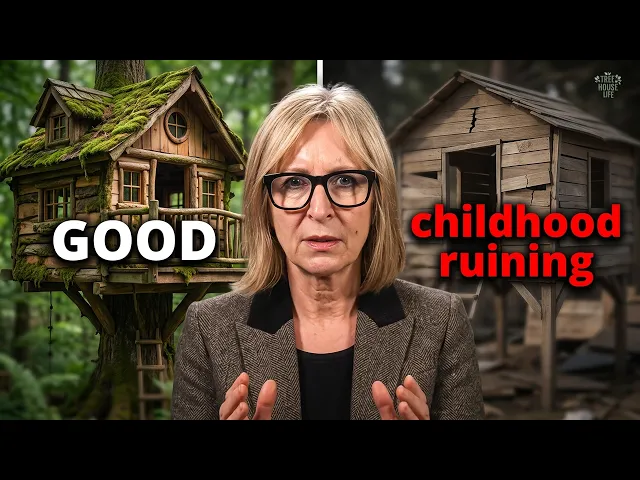
Faced with two treehouses that look broadly similar, most people assume the difference is cosmetic. It rarely is. The deeper distinction lies in how each was made - whether it was handcrafted around a particular family and place, or produced like a factory item and dropped into a garden. That difference is felt long before it is understood, in something often called the "wow factor."
Knowing why a handmade structure carries an emotional weight a manufactured one cannot helps explain what you are really paying for when you commission bespoke outdoor work, and why the easier, more scalable route so often produces something that leaves families cold. The answer turns out to have little to do with timber and everything to do with intent.
If you are weighing a handmade treehouse against a more standardised, factory-built one, the most useful thing to understand is that the gap between them is not mainly about materials or finish. It is about whether the structure was made to satisfy a specific family's wish or simply manufactured to a template. A handcrafted treehouse looks and feels handmade in a way people register instantly, even when they cannot name it - and that felt quality is precisely what families respond to most strongly. The wow factor everyone wants is not an upgrade you bolt on. It is the natural result of something made by hand, with intent, rather than processed into a product.
This is a conviction Paul Cameron has held across twenty-five years of building treehouses, and he is unusually clear about where it comes from. By his own account, the handcrafted character of his company's work exists partly because he is not a carpenter. Coming to the craft without a conventional building background, he held onto a particular perspective - a view that everything should look and feel handmade - rather than drifting toward the cleaner efficiency a trained builder might have pursued. The absence of formal training, often assumed to be a limitation, became the very thing that protected the work from feeling manufactured. What he was protecting was not a style but a feeling: the sense that the structure was made for someone, by someone.
He is candid that holding onto this is genuinely difficult. It is, he admits, much easier to head off toward a factory-built solution. The pressure to do so is constant and comes from a reasonable place - when you look at a treehouse business purely as a business, everyone around you advises you to scale, to systematise, to increase profit. Those instincts are not wrong in the abstract; they are what the textbook teaches. But following them tends to strip out the handcrafted quality that gives the work its emotional charge. Choosing to keep something deliberately handmade, in business terms, means repeatedly declining the more profitable, more scalable path. For anyone commissioning a treehouse, this is worth knowing: a maker who has resisted that pressure is offering you something the market actively pushes against.
The reason it matters becomes clear when you understand what Cameron believes he is actually selling. He is emphatic that it is not a product, not an item lifted from a brochure and placed in a garden. What he is satisfying is a wish - the deep, often unspoken longing a parent has to give their children the best childhood they can. That reframing changes everything about how a treehouse should be made and judged. A manufactured structure can answer a specification. Only a handcrafted one can answer a wish, because a wish is particular to one family, one set of children, one garden, and cannot be met by a template designed for everyone. The handmade quality is not decoration on top of the purchase; it is the medium through which the wish is honoured.
Cameron's certainty on this point is rooted in his own life, and it is the part that gives his expertise real weight. The whole enterprise traces back to his grandfather - a man he describes as his hero, who survived the Battle of the Somme in the First World War and lived to eighty-six - and who built a treehouse for Cameron, his brother and his sister in their back garden when they were small. That memory, he believes, is the trigger for everything that followed. When he later built three treehouses for his own two sons, he was repeating that act of love rather than launching a product line. And when he meets clients now, he recognises the same impulse in them: a mother and father wanting to do something wonderful for their children, and quietly hoping to be a hero in the way his grandfather was to him. A handmade treehouse is the physical form of that wish passing between generations. A factory product cannot carry it.
There is a practical lesson in all this for anyone choosing bespoke outdoor work of any kind, from garden structures to larger family builds. The questions worth asking are not only about timber grades and dimensions but about how the thing is made and why. Does the maker treat each build as a fresh response to a particular family, or as a unit to be replicated? Have they resisted the pull toward standardisation, even at a cost to their own scale and margin? Do they understand the project as satisfying a wish rather than fulfilling an order? The answers tell you whether you will end up with something that merely occupies the garden or something that carries genuine meaning into it.
The most telling detail in Cameron's story is what has happened to that act of love over time. The two boys he built treehouses for, when they were tiny, have both now returned to work in the business after careers elsewhere - choosing, of their own accord, to carry it forward. It was never planned. But it speaks to something a factory model could never produce: a craft, and a set of values, handed down rather than manufactured. The handcrafted look and feel he has fought to preserve is, in the end, inseparable from the human story behind it. That is why it cannot be replicated on a production line, and why families feel the difference the moment they see it.


