Being Niche, embracing Scarcity and always World-Class
How a treehouse builder learned his craft
Subject:
Craftsmanship
You do not need to be a carpenter to build something extraordinary in a tree. That sounds like a contradiction, but it is the quiet truth at the heart of how the UK's longest-standing treehouse company began - with a father who had never trained as a builder, walking into a timber yard for the sake of his two sons.
The skill that mattered turned out not to be joinery at all, but a way of seeing space that came from years spent in theatres and concert halls. For anyone wondering whether imagination or technical training matters more when creating something handcrafted, the answer is more reassuring, and more useful, than you might expect.
The most common assumption about treehouse building is that it begins with carpentry. It does not. The more honest starting point is a way of seeing - an ability to look at a tree, a garden, a stretch of open ground, and picture what a space could become. Technical skill can be hired, partnered with, or learned along the way. The creative instinct that decides what is worth building in the first place is harder to acquire, and it is the thing that separates a memorable structure from a competent one.
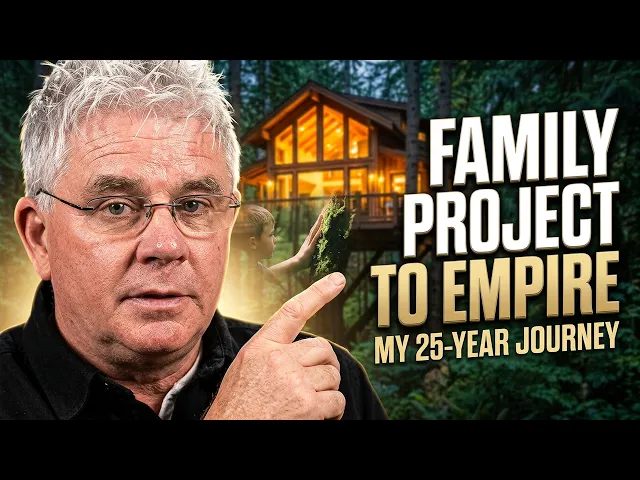
This is the lesson at the centre of how Treehouse Life founder Paul Cameron came to his craft. By his own account, he is still not a carpenter. He began as a self-described "typical dad," building three treehouses for his two boys, Elliott and Charlie - both of whom now work in the business. He walked into the local timber store, came back with a load of timber, and set about creating a space for his sons with, in his words, no real knowledge of building. What he had instead was somewhere far more unusual to draw from.
Cameron's first career was as a session drummer, trained at the Royal College of Music, with years spent working across films, television, theatre and orchestras. It was in those theatres and on those film sets that he absorbed the discipline that would later define his treehouses. He watched how directors and stagecraft teams conjured atmosphere - building worlds not from technical drawings but from sets, light and sound. That was his school of design. When he turned to timber, he did not approach it as a builder approaching a structure; he approached it as someone who had spent years learning how a space is made to feel magical. That distinction is the whole story. A treehouse, in this understanding, is closer to a stage set than to a shed.
For anyone learning a hands-on craft later in life, or without a formal trade behind them, there is a genuinely freeing insight here. The absence of conventional training can become an advantage rather than a limitation. Cameron describes simply "free-flowing" with the work, unconstrained by the rules a carpenter might have felt bound to follow. Not knowing the orthodox way of doing things left him open to imagining structures purely around how his children would play in them. The expertise he lacked in joinery, he more than matched in knowing what a space was for - and that is the harder, more valuable knowledge.
What makes this more than a charming origin story is how deliberately he then handled the gap in his skills. When friends and family began praising what he had built, and a bored afternoon wandering the Ideal Home Show revealed that nobody there was selling treehouses, he recognised an opening. He returned the following year with the smallest, cheapest stand at the back of the hall - no product, just a brochure, a basic website, and photographs of his three garden treehouses shot across different seasons and angles to suggest a fuller body of work. He came away with forty-four leads, around half of whom became clients. The cold sweat of sudden demand forced the decisive move: he brought a skilled carpenter into the fledgling business and matched those technical abilities with his own creative spirit. Within twelve months, that back-of-hall stand had become the largest main stand at the show, sixty square metres with three treehouses on it.
The practical lesson in that progression is worth holding onto. Cameron did not try to become a master carpenter to legitimise his vision. He understood precisely what he was good at - and, just as importantly, what he was not - and built a team around the difference. He still cheerfully admits he gets told to get off site when it comes to cutting wood. Knowing the limits of your own craft, and respecting the people who hold the skills you lack, is itself a form of expertise. The handcrafted character that defines the company's work survives precisely because the person at its centre never stopped being a creative spirit rather than a tradesman.
He returns often to a metaphor drawn from his old life: he runs the business like a rock band, and he is still the drummer. The drummer's role is not to be the most visible member but to hold the rhythm, to lift the band from a verse into a chorus, to take everyone with him. A band, he points out, does not work with four bass players - it needs a bass player, a guitarist, a drummer, a singer, each contributing something the others cannot. Applied to a craft business, it is a quietly sophisticated idea about how creativity and technical skill are meant to fit together. No single discipline carries the whole thing. The maker's job is to keep the rhythm and let each skill do what it does best. There is also a lesson here about how good craft is sustained over time. Cameron learned, as a drummer, that you earned next week's gig by making the singer sound good - by playing with energy and conviction so the audience stood up and danced. That instinct to serve the larger performance carried directly into how he builds. A treehouse succeeds not when it displays the builder's skill, but when it makes a family feel something. Craft, in this framing, is never an end in itself. It is in service of the experience, the play, the years of childhood a structure will quietly hold.
For anyone drawn to making things with their hands - to sustainable building, to outdoor structures, to creating spaces where families gather and children play - the encouragement is clear. Vision and instinct can lead, and the technical mastery can be assembled around them. The most enduring handcrafted work often comes from people who never followed the conventional path, and who were therefore free to imagine something the rulebook would never have allowed. The full conversation traces this journey in richer detail - the timber-yard beginnings, the bold gamble at the Ideal Home Show, and how a drummer's ear became a builder's eye. It is well worth watching to hear how an unlikely craft was learned in full.